Repair TipsLocal Guides
Why Your Water Softener Uses Too Much Salt
Your softener is eating salt because of hardness settings, salt bridges, or tired resin. Here's how Diamond Bar homeowners cut salt use without losing soft water.
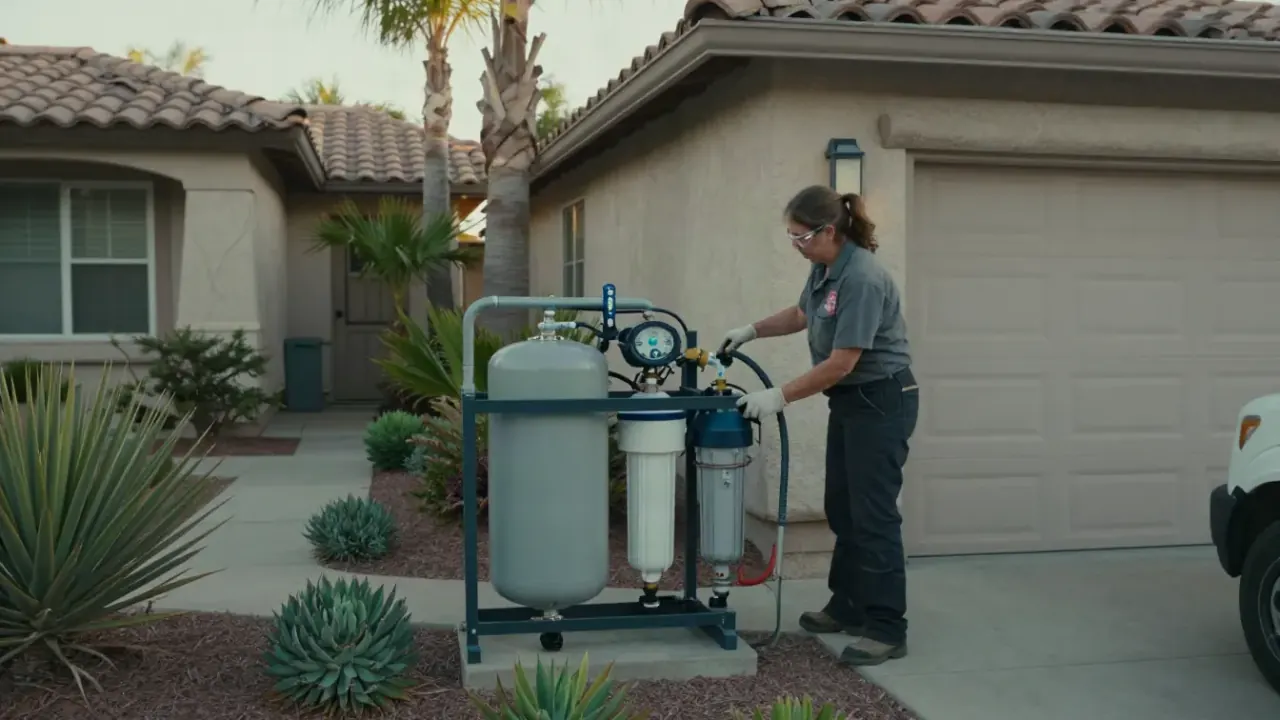
Your water softener uses too much salt because it is regenerating more often than your actual water hardness requires. That usually traces back to one of four things: a hardness setting that is too high, a salt bridge or mushy brine tank, a failing control valve, or resin beads that have stopped doing their job. The rest of this post walks through how to tell which one you have, what it costs to fix in 2026, and how Diamond Bar homeowners cut salt use by 20-40% without giving up soft water.
Water softener salt consumption high enough to notice is rarely a mystery once you know what to look for. A family of four in Diamond Bar with a correctly tuned softener should burn through roughly one 40-lb bag of salt every four to six weeks. If you are hauling bags home every ten days, something is off.
The Short Answer: Your Softener Is Regenerating Too Often
A water softener is a tank of resin beads that swap calcium and magnesium for sodium, then flush themselves clean with a salty brine rinse called regeneration. Every regeneration cycle consumes salt. The more often the unit regenerates, the more salt you buy.
Regeneration frequency is driven by two numbers: how hard your water actually is, and how many gallons your household pulls through the system each day. Diamond Bar water runs hard, and in some pockets of the city it is very hard. When either number is wrong in the control head, salt waste follows.
Here is the baseline most homeowners should be measuring against:
- Water hardness in Diamond Bar: commonly 12-18 grains per gallon (gpg), with some wells and blended supplies pushing higher.
- Salt use for a family of four: one 40-lb bag every 4-6 weeks.
- Regeneration frequency: every 6-10 days on a properly sized unit.
- Brine tank salt level: salt should sit at least a few inches above the water line, never buried in a solid crust.
If your numbers look nothing like that, keep reading. The cause is almost always in the next section.
Why Is My Water Softener Using So Much Salt in Diamond Bar CA?
In Diamond Bar, high salt usage almost always comes down to a mismatch between your softener's programmed hardness and the actual hardness coming out of the tap. Municipal supply here is a blend, and hardness shifts through the year as the district pulls from different sources. A unit set to 10 gpg in January can be under-regenerating by summer and over-regenerating by winter.
There is a second Diamond Bar-specific factor worth knowing. Many homes here were built between the late 1970s and the mid-1990s, and a good number still run the original or second softener installed when the house was new. Those older mechanical control heads do not measure water use. They regenerate on a fixed timer, whether you have used 200 gallons that day or 2,000. That single design flaw is why so many older Diamond Bar units go through salt like it is free.
If you are on a well or a shared private supply anywhere in the hills, hardness can swing even more. We see this regularly with clients on The High Country Water Softener systems, where a single hardness setting rarely holds up across the whole year.
So the honest answer to "why is my water softener using so much salt in Diamond Bar CA" is: your unit is guessing, and it is guessing wrong. Modern metered heads solve most of this. Older timer heads need either replacement or a much more careful setup.
The Usual Suspects, Ranked by How Often We See Them
When we open a brine tank or pull a control head in Diamond Bar, these are the causes we find, in roughly this order of frequency.
1. Hardness setting is too high
This is the number one cause and the cheapest to fix. If your water is 14 gpg and the softener is programmed for 25, it will regenerate almost twice as often as it needs to. That is a 40-50% salt waste with zero benefit. A five-minute hardness test tells you the right number.
2. Salt bridge or mushy brine
A salt bridge is a hard crust that forms across the top of the salt, leaving a hollow void underneath. The softener thinks it has brine to draw, but it does not, so it keeps cycling and keeps wasting salt. You can test for one by gently pushing a broom handle down into the salt. If it drops through easily, you have a bridge.
Mushy brine is the opposite problem: too much water in the tank, salt turning to sludge, and the brine pickup tube clogged. Both conditions cause the same symptom - high salt use with water that still feels hard.
3. Control valve or brine valve failure
The control head runs the whole cycle. When a piston, seal, or brine valve starts to fail, the unit can get stuck mid-regeneration, draw too much water into the brine tank, or skip the brine draw entirely. Any of those will spike salt consumption. This is the point where a rebuild kit or a new head is the right call, not more troubleshooting.
4. Exhausted resin
Resin beads last 10-15 years on average. After that they fracture, lose capacity, and stop grabbing hardness minerals. A softener with dead resin will run longer and longer cycles trying to do a job it physically cannot do. Salt use climbs, water gets hard, and no amount of reprogramming fixes it. Resin replacement is the answer.
5. Undersized unit
A softener sized for a two-person condo will not keep up with a five-person Diamond Bar household running irrigation, a pool top-off, and three showers at once. It regenerates constantly and never quite catches up. If your unit is more than one size too small for your home, replacement usually pays for itself in salt savings within two to three years.
How to Reduce Salt Consumption in Water Softener Diamond Bar Systems
Reducing salt use is a sequence, not a single trick. Do these in order and you will usually cut consumption by a third without touching the hardware.
- Test your actual hardness. Do not trust the number the installer wrote on the tank ten years ago. Water chemistry changes. A current test is the foundation for everything else.
- Reprogram the control head. Set hardness to the tested value. Set the capacity to match your household size. If your head supports variable reserve or "high efficiency" mode, turn it on - it saves 15-25% on salt by itself.
- Check the brine tank. Break up any crust, remove undissolved salt, and make sure the brine well is clear. If the tank has not been cleaned in years, this alone can restore normal salt use.
- Verify the brine draw. Watch a full regeneration cycle. The unit should pull brine from the tank and refill to a consistent level. If the level is wrong, the brine valve needs attention.
- Inspect the resin. Pull the tank lid and look at the bed. Healthy resin looks like small amber beads. If it looks like sand or mush, it is done.
For homeowners who want the softener dialed in properly the first time, our Water Softener Maintenance Diamond Bar CA service covers hardness testing, control head programming, brine tank cleaning, and a full regeneration check in one visit.
If your water is hard but you would rather not deal with salt at all, a Salt-Free Water Conditioners Diamond Bar CA setup is worth a conversation. It will not soften water the way an ion-exchange unit does, but it stops scale and eliminates salt hauling entirely.
Common Mistakes That Waste Salt
We see the same handful of mistakes over and over when we service softeners around Diamond Bar. Each one quietly adds to your salt bill.
- Filling the brine tank to the top. Salt needs room to dissolve. Overfilling creates bridges and mush. Keep it about half to two-thirds full.
- Using the wrong salt. Pellets, crystals, and block salt behave differently. Most residential units in Diamond Bar do best on high-purity pellets. Block salt is for commercial units and will bridge in a home tank.
- Ignoring the bypass. If the bypass valve is partially open, hard water mixes with softened water, the unit works harder, and salt use climbs.
- Setting hardness "just to be safe." Programming 30 gpg when your water is 14 gpg does not make the water softer. It just makes the softener regenerate twice as often.
- Skipping annual service. A softener that has not been opened up in three years is running blind. Small valve issues become big salt bills.
One more mistake worth calling out: assuming all hard water problems are softener problems. If your softener is fine but your fixtures are still scaling, the issue may be elsewhere in the water line. That is a different diagnosis, and it is one we handle through Water Hardness Testing Diamond Bar CA before recommending any hardware.
When to Call a Professional
Call a professional when the easy fixes do not move the needle. If you have tested your hardness, reprogrammed the head, cleaned the brine tank, and you are still buying salt every two weeks, the problem is inside the unit - valve, resin, or sizing - and it needs hands-on diagnosis.
We also get called when a softener is stuck mid-cycle, leaking at the brine line, or showing an error code that will not clear. Those are not DIY repairs. Opening a pressurized control head without the right parts and torque specs usually turns a $200 fix into a $700 one.
Our team works across Diamond Bar and the surrounding hills, including neighborhoods like Sycamore Canyon Water Softener where larger lots and heavier water use tend to expose undersized systems fast. If your unit is more than 12 years old and salt use has crept up year over year, we will tell you honestly whether a tune-up will fix it or whether it is time to replace it.
If you are starting from scratch or replacing a dead unit, we install and program every system to your actual tested hardness, not a generic default. You can see how we approach that on our Water Softener Installation Diamond Bar CA page.
Frequently Asked Questions
Why is my water softener using too much salt in Diamond Bar CA?
Most often the hardness setting is higher than your actual water hardness, so the unit regenerates too frequently. Salt bridges, a failing brine valve, and exhausted resin are the next most common causes. A hardness test and a full regeneration cycle check will identify which one you have within an hour.
How can I reduce salt usage in my water softener in California?
Test your water, set the control head to the real hardness number, enable high-efficiency or variable reserve mode if available, keep the brine tank half full, and clean it once a year. Those five steps typically cut salt use by 20-40% on a unit that has never been tuned.
Is high salt usage normal for a water softener in Diamond Bar?
No. A family of four on properly programmed equipment should use one 40-lb bag every four to six weeks. If you are going through a bag every ten days, something is wrong - usually programming, a salt bridge, or aging resin. Normal use is predictable and steady, not creeping upward.
How long does water softener resin last?
Resin typically lasts 10-15 years in Diamond Bar's water. After that, beads fracture and lose capacity, so the softener runs longer cycles and burns more salt without producing soft water. If your unit is over a decade old and salt use is climbing, resin is a likely culprit.
Can I switch to a salt-free system to stop buying salt?
Yes, if scale prevention matters more to you than true softening. Salt-free conditioners stop calcium from sticking to pipes and fixtures but do not remove hardness minerals. They eliminate salt hauling entirely, which is why many Diamond Bar homeowners consider them when salt use becomes a chore.
Get Help with Water Softener in Diamond Bar
If your softener is burning through salt and you have already tried the basics, we can diagnose it properly and get your consumption back to normal. We test your water, inspect the valve and resin, and program the unit to your actual household demand - no guesswork.
Call Diamond Bar Water Softener at (909) 415-2296 to schedule a service visit. We work throughout Diamond Bar and the surrounding hills, and we will tell you upfront what the fix costs before we start.