Repair TipsLocal Guides
What a Softener Control Valve Does
The control valve is the brain of your water softener. Here is what it does, how it fails, and when Diamond Bar homeowners should call for repair.
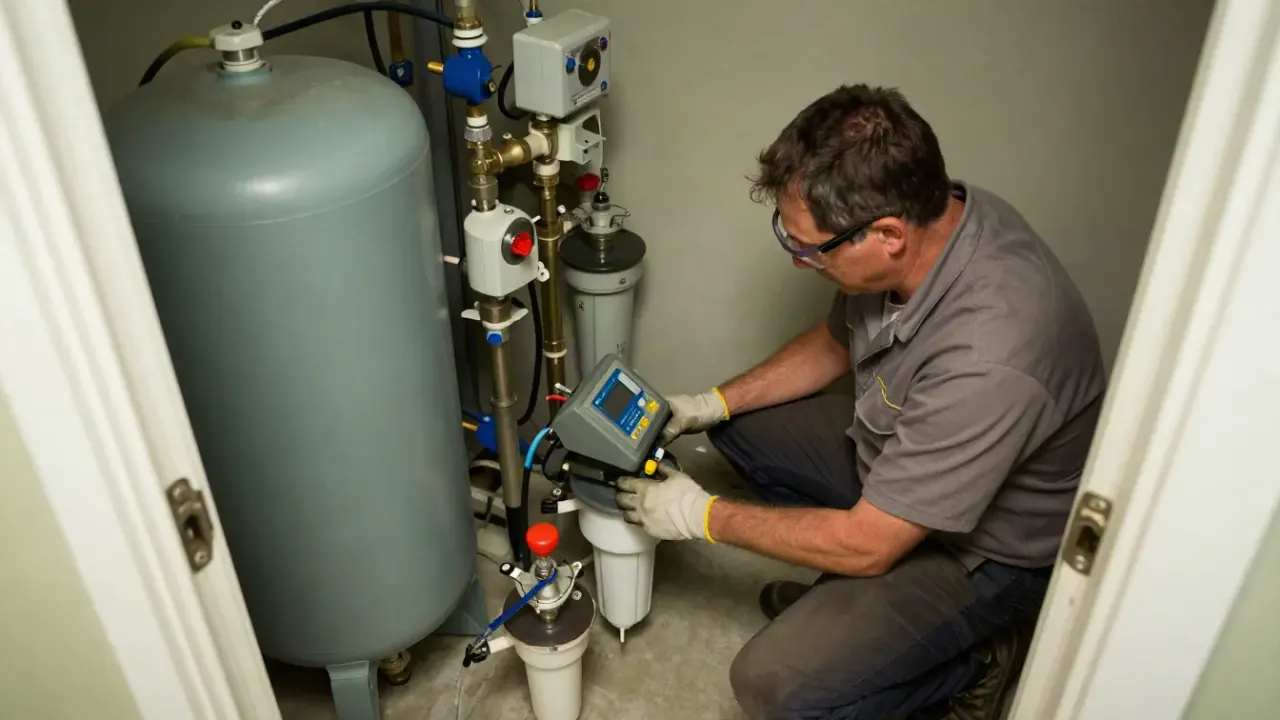
A softener control valve is the motorized assembly on top of your brine tank that opens and closes the water paths through your softener, deciding when hard water flows to the house and when the resin gets regenerated with brine. It is the brain and the traffic cop of the whole system - the resin tank only softens water when the valve routes it there, and the resin only stays effective when the valve sends saltwater through it on schedule. If the valve sticks, leaks, or loses its time setting, you get hard water at every tap even though the tank is full of salt.
This post breaks down what the valve actually does cycle by cycle, the valve types we see across Diamond Bar, the settings that matter, the failure modes that show up most, and when it is worth repairing versus replacing. We work on these valves every week, so the details below are the ones that actually matter in the field.
What a Softener Control Valve Does, in Plain Terms
A softener control valve is a multi-port hydraulic switch that sequences your softener through its service and regeneration stages, using a piston or disc stack driven by a small motor and timed by a controller board. In service mode, the valve sends hard water from your main line down through the resin bed, where calcium and magnesium ions swap onto the resin beads and softened water flows out to the house. In regeneration mode, the same valve reverses and re-routes flow so brine from the salt tank is drawn up, pushed down through the resin, and flushed to drain - resetting the beads so they can soften again.
That is the entire job. Everything else - the timer, the meter, the bypass, the brine line - supports that one function. When people ask what a softener control valve does in Diamond Bar CA, the short answer is: it decides where the water goes and when. Nothing in the system works without it.
If you are still deciding on equipment for a home here, our team handles Water Softener Installation Diamond Bar CA and can walk you through valve options before you buy. For most Diamond Bar households, the valve is the single most important component to get right on day one.
How a Water Softener Valve Works Through a Regeneration Cycle
How a water softener valve works comes down to five stages, and each one has a specific job. A typical Fleck or Clack-style control head runs through them in roughly 60 to 90 minutes, usually at 2 a.m. when nobody is showering.
- Backwash (8-12 minutes): the valve reverses flow upward through the resin tank to lift out trapped sediment and loosen the bed.
- Brine draw (45-60 minutes): the valve opens the brine line, pulls saltwater from the tank, and pushes it down through the resin so the calcium and magnesium ions swap off the beads.
- Slow rinse (20-30 minutes): fresh water continues through the bed at a slow rate to push the remaining brine out.
- Fast rinse (5-10 minutes): full-flow water flushes the last of the brine to drain so you do not taste salt at the tap.
- Brine refill (5-15 minutes): the valve sends a measured amount of water back into the salt tank to dissolve the next batch of salt.
Each stage is set by the piston position inside the valve body. If the piston seal wears out at year six or seven, you will see water bypassing during service - meaning hard water sneaks past the resin and reaches your fixtures. That is the most common silent failure we find on service calls.
Water Softener Valve Types You Will See in Diamond Bar Homes
Water softener valve types fall into three families, and knowing which one you have tells you a lot about repair cost and reliability. Diamond Bar sits on some of the hardest water in the San Gabriel Valley - 12 to 18 grains per gallon is typical - so valves here cycle more often than valves in softer-water cities, which shortens their service life.
Mechanical Timer Valves
These use a rotating dial and a small gear motor to trigger regeneration on a fixed schedule, usually every 3 to 7 days. They are simple and cheap to fix, but they regenerate on the clock rather than on actual water use, so they waste salt and water. You still see them in homes built in the 1980s and 1990s around Water Softener in Diamond Point and similar older tracts.
Metered Demand Valves
The controller counts gallons through a turbine or paddle wheel and only regenerates when the resin is actually exhausted. Most systems installed in the last 15 years use this design. Set the hardness correctly and a metered valve will cut salt use by 25 to 40 percent compared to a timer unit.
Fully Electronic / Digital Valves
These add a display board, programmable hardness, variable brining, and sometimes Wi-Fi diagnostics. They are the most accurate but also the most sensitive to power surges - a real issue in parts of Diamond Bar where summer brownouts are common.
Understanding Water Softener Valve Settings in Diamond Bar
Understanding water softener valve settings in Diamond Bar starts with two numbers: your actual water hardness and your household size. Get those wrong and the valve will either regenerate too often (wasting salt) or not often enough (hard water at the tap).
For a Diamond Bar home on Metropolitan Water District supply, hardness runs about 12 to 16 grains per gallon. A family of four using 250 gallons a day needs the valve set around 14 grains and a capacity of roughly 24,000 to 32,000 grains per regeneration. A family of two can drop that by a third.
- Hardness setting: set it 2-3 grains higher than your test result to account for iron and seasonal shifts.
- Regeneration time: 2 a.m. is standard; avoid 6-8 p.m. when the house is using water.
- Salt dose: 6-9 lbs per regeneration is typical for a 1-cubic-foot resin tank.
- Days override: set to 7-14 days as a backup in case the meter stops counting.
If you have never had your water tested, a Water Hardness Testing Diamond Bar CA visit takes about 20 minutes and gives you the exact number to punch into the valve.
Water Softener Valve Problems Diamond Bar Homeowners Run Into
Water softener valve problems in Diamond Bar usually show up as one of six symptoms, and each one points to a specific part inside the control head.
- Hard water returns while salt is full: worn piston seal or a stuck brine line - the valve is not drawing brine.
- Constant drain flow: a stuck piston or a failed seal lets water run to drain 24/7. This can add $40-$80 a month to your water bill.
- Salt bridge or salt mush in the tank: the brine refill stage is under-filling, so the tank never dissolves salt properly.
- Error codes on the display: usually a failed motor, position switch, or board - common after a power surge.
- Water tastes salty: the fast rinse stage is too short or the valve is not fully seating between stages.
- Valve leaks at the body: O-rings and seals dry out and crack after 8-10 years, especially on units in garages that hit 100°F+ in summer.
Most of these are fixable without replacing the whole softener. A seal-and-piston kit runs $60-$120 in parts and takes our techs about 90 minutes. A full control head replacement runs $250-$450 installed in 2026 pricing, depending on the brand and whether the resin tank is still in good shape.
If the resin itself is exhausted - usually at the 10-12 year mark - we would pair the valve work with Resin Tank Replacement Diamond Bar CA so you are not paying for two service visits.
Common Mistakes We See With Control Valve Repair
The biggest mistake is replacing the whole softener when only the valve is bad. A control head is a wear item; the resin tank and brine tank usually outlast two or three of them. If your tank is sound and the resin still tests good, a valve swap is the cheaper fix by hundreds of dollars.
The second mistake is ignoring the bypass valve. When a softener is bypassed for service and never switched back, every fixture in the house runs hard water and the homeowner blames the control valve. We check the bypass first on every call.
The third is guessing at settings. We regularly find valves programmed for 25 grains when the actual water is 14, which forces the unit to regenerate every other day and burns through a 40-lb bag of salt in three weeks. That is a $12-$15 per bag cost you do not need to pay.
Finally, homeowners sometimes try to force a stuck piston with pliers or a screwdriver. That cracks the valve body and turns a $120 repair into a $400 replacement. If the piston will not move by hand during a manual regeneration, stop and call us.
When to Call a Professional
Call a professional when the valve will not advance through its cycles, when water is running to drain continuously, or when you see error codes you cannot clear by unplugging the unit for 60 seconds. Those three symptoms almost always mean a failed motor, position switch, or piston seal - parts that require opening the control head and re-seating O-rings under pressure.
Our team handles Softener Valve and Control Head Repair Diamond Bar CA with same-week scheduling, and we carry the common Fleck, Clack, and Autotrol parts on the truck. If the valve is beyond saving, we will tell you straight and quote a replacement before we start. For homeowners in the hillside neighborhoods near Water Softener in Sycamore Canyon, we also check for pressure-related wear since those homes often sit at the top of the zone.
Frequently Asked Questions
What does a water softener control valve do in Diamond Bar CA?
It routes water through your softener in the right sequence: service mode sends softened water to the house, and regeneration mode draws brine through the resin to reset it. Without a working valve, the resin never regenerates and every tap runs hard. Diamond Bar water averages 12-16 grains per gallon, so the valve cycles often.
How do I know if my water softener valve is bad in California?
Three signs point to a bad valve: hard water returns while the salt tank is full, water runs to drain constantly, or the display throws an error code you cannot clear. A fourth sign is salt that never seems to go down - that usually means the brine draw stage has failed.
Can I replace a water softener control valve myself in Diamond Bar?
You can, but it is not a beginner job. The valve sits under household water pressure, the inlet and outlet fittings need to be re-sealed, and miswiring the motor or position switch will fry the board. Most homeowners are better off paying $250-$450 installed than risking a cracked valve body or a flooded garage.
How long does a softener control valve last?
Expect 7 to 12 years on Diamond Bar water. Valves in garages that see 100°F+ summer heat tend to fail on the shorter end because the seals dry out faster. Annual service and a $60-$120 seal kit at year seven will usually stretch it to the upper range.
What does a control valve cost to repair versus replace?
A seal-and-piston rebuild runs $150-$300 installed. A full control head replacement runs $250-$450 installed in 2026 pricing. If the resin is also exhausted at the 10-12 year mark, bundling both jobs saves you a second service call.
Get Help With Water Softener in Diamond Bar
If your softener is passing hard water, running to drain, or throwing codes, we can diagnose the valve and get you back to soft water fast. We serve Diamond Bar and the surrounding San Gabriel Valley with same-week appointments and upfront pricing on every repair.
Call Diamond Bar Water Softener at (909) 415-2296 and we will get a tech out to look at your control valve.