Local GuidesWater Quality
How to Tell If You Have Hard Water at Home
Spot the signs of hard water in your Diamond Bar home, test it yourself, and learn when to call a water softener professional.
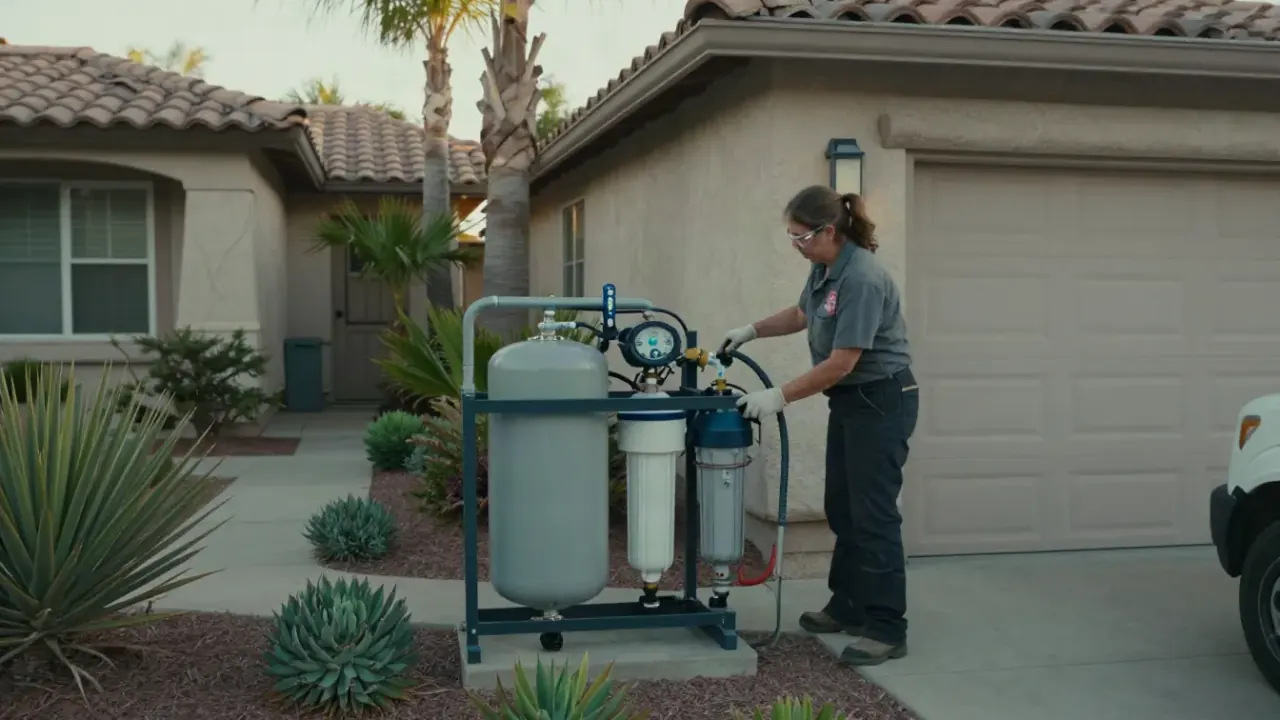
You have hard water at home if your soap refuses to lather, your faucets and shower doors collect a chalky white film, and your skin feels dry and tight after every shower. In Diamond Bar, where most homes run on Colorado River water that starts out at 8 to 12 grains per gallon, those signs show up fast - usually within a few weeks of moving in. This guide walks you through the specific signals to check, two simple tests you can run today, and how to know when it is time to call a water softener professional.
What Is Hard Water and Why Does It Matter in Diamond Bar?
Hard water is water that carries a high concentration of dissolved calcium and magnesium minerals. The U.S. Geological Survey classifies anything above 7 grains per gallon (gpg) as hard, and above 10.5 gpg as very hard. Diamond Bar sits in a region where the municipal supply routinely tests between 8 and 14 gpg, depending on the blend from the Metropolitan Water District and local groundwater. That means most houses here are solidly in the hard-to-very-hard range.
Those minerals are not a health hazard. They are a plumbing and appliance hazard. Every time water heats up or evaporates, the calcium and magnesium stay behind and form scale - the same stuff as the white crust inside a tea kettle. Over a year, a tankless water heater can lose 10 to 15 percent of its efficiency to scale buildup. A dishwasher can start etching glassware. A washing machine can wear out its bearings two or three years early. We see this constantly in homes across Water Softener in Diamond Point, where the housing stock is mostly 1980s and 1990s builds with original copper lines that have been scaling up for decades.
Signs of Hard Water at Home: What to Look For
The signs of hard water at home fall into four categories: soap and cleaning, fixtures and surfaces, appliances, and your own skin and hair. You do not need a lab to spot most of them. Walk through your house with this list and count how many apply.
Soap and Cleaning Signals
- Bar soap leaves a sticky, curdled film on your hands instead of a clean lather.
- Shampoo takes two or three rinses before your hair stops feeling coated.
- Laundry comes out of the wash feeling stiff or scratchy, even with fabric softener.
- You use noticeably more detergent than the bottle recommends to get dishes clean.
That film is soap scum - the insoluble residue left when soap reacts with calcium. Soft water lets soap do its job with roughly half the product.
Fixture and Surface Signals
Look at the base of your kitchen faucet, the rim of the toilet bowl, and the shower door. Hard water leaves a white, chalky crust called limescale. On chrome it looks like cloudy spots that do not wipe off. On glass it looks like frosted etching. On tile grout it turns white and rough. If you can scrape a fingernail across it and get a powdery residue, that is scale, not soap scum.
Appliance Signals
Hard water problems in Diamond Bar houses show up in appliances first because they heat or agitate water. A water heater that rumbles or pops is boiling through a layer of scale on the heating element. A dishwasher that leaves spots or a white haze on glasses is not rinsing clean. A washing machine that smells musty or vibrates more than it used to may have mineral buildup in the drum. These are expensive symptoms - a failed water heater runs $1,200 to $2,500 installed in 2026 pricing around here.
Skin and Hair Signals
Yes, hard water can make your skin dry. The minerals bond with your natural oils and soap residue, leaving a film that blocks moisture. People with eczema or sensitive skin often notice it first - itching and flaking that gets worse in winter. Hair feels dull, tangles more, and color-treated hair fades faster because the cuticle stays rough.
How to Test for Hard Water at Home
You can test for hard water two ways without buying lab equipment: a soap lather test and a strip or titration kit. Both take under ten minutes.
The Soap Lather Test
- Fill a clear 16-ounce bottle with tap water.
- Add 10 drops of pure liquid castile soap (no detergents or fragrances).
- Cap it and shake hard for 10 seconds.
- Set it down and look at the water.
Soft water produces a thick, lasting layer of suds. Hard water produces few bubbles and a cloudy, milky look. The more cloudiness, the harder the water. This test will not give you a number, but it will tell you whether you have a problem worth measuring.
Test Strips and Titration Kits
Hardness test strips cost $10 to $20 at any hardware store or online. Dip the strip in a cup of tap water for one second, shake off the excess, and wait 15 seconds. Compare the color to the chart. Titration kits, which use drops and a color change, run $20 to $40 and are accurate to within 1 gpg - good enough to size a softener. For a precise reading, our team offers Water Hardness Testing Diamond Bar CA at no charge, and we test both the raw incoming water and the treated water so you know exactly what you are dealing with.
One tip: test cold water straight from the tap, not hot. Hot water can concentrate minerals and give you a falsely high reading.
Hard Water vs Soft Water: What Changes When You Fix It
The difference between hard water and soft water is measurable, and it shows up in your monthly bills and your daily routine. Soft water contains less than 1 gpg of calcium and magnesium. Here is what changes when you install a properly sized softener:
- Soap and shampoo lather with about half the product.
- Water heater efficiency improves by 10 to 15 percent, saving $80 to $150 a year on gas.
- Appliances last 30 to 50 percent longer on average.
- No more scrubbing scale off faucets and shower doors.
- Skin and hair feel cleaner because there is no mineral film left behind.
We install Water Softener Installation Diamond Bar CA for homes on city water and for the handful of properties still on private wells. A standard 32,000-grain unit fits most three-bedroom houses here and runs $1,800 to $3,200 installed in 2026, depending on whether we need to upgrade the loop or add a bypass.
Common Mistakes When Diagnosing Hard Water
The biggest mistake is assuming a water filter solves hardness. It does not. A standard carbon filter removes chlorine and taste, but it passes calcium and magnesium straight through. If you want soft water, you need an ion-exchange softener or a salt-free conditioner - not a Brita pitcher or a fridge filter.
The second mistake is testing only one faucet. Hardness is usually uniform across a house on municipal water, but if you have a water softener that is failing, the cold kitchen tap may be bypassed while the rest of the house is treated. Test both a treated and an untreated line if you already have equipment.
The third mistake is ignoring the water heater. If your softener has been offline for months, the scale is already baked onto the tank. You may need a flush or, in bad cases, a replacement. We handle Water Softener Repair Diamond Bar CA and can tell you in one visit whether the unit is worth saving.
Finally, do not size a softener by guesswork. A unit that is too small will regenerate every day and waste salt; one that is too large will sit stagnant. We size by grain count, household size, and peak flow - usually 1.5 to 2.5 gallons per minute for a family of four.
When to Call a Professional
Call us when your test strips read above 7 gpg and you are already seeing scale on fixtures, or when your existing softener is using more salt than usual, leaking at the brine tank, or leaving the water still feeling hard. Those are signs the resin is exhausted or the valve is stuck. We can usually diagnose over the phone and schedule a same-week visit.
If you are in one of the older neighborhoods - say Water Softener in Windwood or the homes off Diamond Bar Boulevard - we often find original plumbing that has never been treated. A quick inspection tells us whether you need a full install or just a tune-up. Our team carries test kits, resin, and valves on every truck, so most jobs are done in a single trip.
Frequently Asked Questions
How do I know if I have hard water in Diamond Bar CA?
Check for soap that will not lather, white scale on faucets, and dry skin after showers. Test with strips - if your reading is above 7 grains per gallon, you have hard water. Most Diamond Bar homes test between 8 and 14 gpg.
What are common signs of hard water in California homes?
Spotty dishes, stiff laundry, scale on shower doors, and a rumbling water heater are the top four. California's Colorado River supply is naturally hard, so these signs appear in most inland homes within weeks of move-in.
Can hard water make my skin dry?
Yes. The calcium and magnesium leave a residue that blocks moisture and strips natural oils. People with eczema often see itching and flaking worsen. A softener usually clears it up within two weeks of installation.
How accurate are home hard water test strips?
Strips are accurate to within 2 to 3 grains per gallon - good for a yes-or-no answer. For sizing a softener, use a titration kit or call us for a free professional test that reads to within 1 gpg.
Do I need a water softener if I already have a filter?
Yes, if your goal is soft water. Carbon filters remove chlorine and taste but not hardness minerals. You need an ion-exchange softener or a salt-free conditioner to actually reduce calcium and magnesium.
Get Help with Water Softener in Diamond Bar
If your tests point to hard water, we can confirm it and fix it. Diamond Bar Water Softener installs, repairs, and maintains softeners for homes across the city - from Diamond Point to The Country. Call (909) 415-2296 to schedule a free hardness test and a no-pressure quote.